Cosmos: Reading Strange Signals
The universe is not silent; it is saturated with transient electromagnetic pulses, distorted gravitational spacetime waves, and light stretched by cosmic expansion over thirteen billion years.
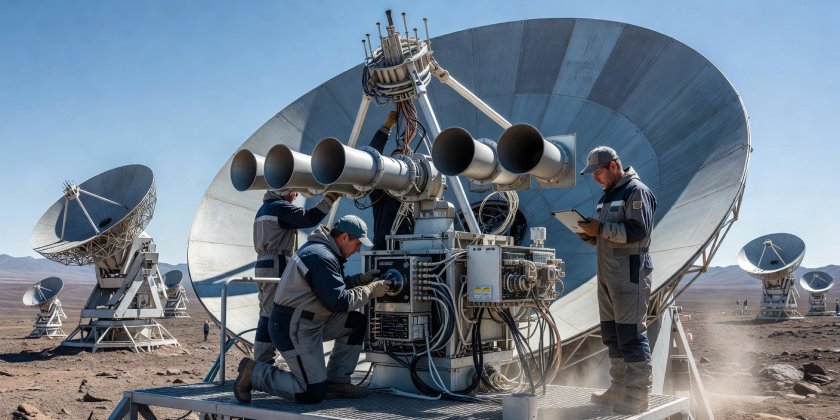
Field engineers inspecting cryogenic receiver dewars on a high-altitude millimeter dish array. Real astronomy advances through radio frequency sensitivity and low-noise preamps.
Fast Radio Bursts (FRBs): The Magnetar Connection
First recorded in archival data by Duncan Lorimer in 2007, Fast Radio Bursts are millisecond-duration flashes of coherent radio waves originating from cosmological distances. The dispersion measure (DM)—the delay of lower-frequency radio waves relative to higher-frequency ones caused by electrons in the intergalactic medium—proves these events originate far outside our Milky Way galaxy.
In April 2020, telescopes detected an intense radio burst matching FRB energy profiles originating from SGR 1935+2154, an active magnetar located inside our own galaxy. Magnetars possess magnetic fields exceeding $10^{14}$ to $10^{15}$ Gauss—strong enough to warp electron orbitals into thin needles. A sudden "starquake" on the neutron star's solid crust snaps magnetic flux lines, driving relativistic plasma shocks that release energetic bursts.
Cosmic Phenomena Under Active Observational Audit
| Phenomenon | Detecting Instrument | Physical Mechanism | Theoretical Resolution |
|---|---|---|---|
| Repeating Fast Radio Bursts | CHIME Radio Array (Canada), FAST (China) | Magnetar crustal reconnection or binary pulsar interactions | High statistical probability of young, rapidly rotating magnetar engines |
| Gravitational Wave Ringdowns | LIGO / Virgo / KAGRA Laser Interferometers | Inspiral and coalescing mergers of binary black holes and neutron stars | Confirms general relativity Kerr metric in strong-field regimes |
| Over-Massive Early Galaxies | JWST NIRCam / NIRSpec Infrared Spectrometers | High stellar mass accumulation within 400 million years of Big Bang | Unresolved; forces revision of early dark matter halo gas cooling models |
Gravitational Wave Astronomy: Sensing Ripples in Spacetime
Until 2015, all astronomical data was derived from electromagnetic radiation (photons). The detection of GW150914 by the Laser Interferometer Gravitational-Wave Observatory (LIGO) inaugurated a non-photonic channel. When two black holes spin into each other, they radiate pure spacetime curvature ripples at the speed of light.
The laser beams traveling down LIGO’s 4-kilometer perpendicular vacuum tubes measure changes in distance smaller than one ten-thousandth the diameter of a proton. By analyzing the wave's frequency chirp and amplitude decay (ringdown), astrophysicists directly calculate the final black hole's mass, spin, and the total energy converted directly into gravitational radiation.
The Enigma of Early Cosmic Structure
Deep infrared observations from the James Webb Space Telescope have revealed galaxies at redshifts $z > 10$ that contain orders of magnitude more stellar mass than predicted by standard $\Lambda\text{CDM}$ cosmological models. According to classical galaxy formation theory, the universe at 350 million years old should not have had enough time to collapse gas into such dense starburst engines.
Astrophysicists are evaluating whether supermassive black hole seeds formed directly from massive gas clouds without a precursor star generation (direct collapse black holes), or if the early stellar population III stars were drastically more massive and efficient at star formation than modern stars.