Satellites: What Orbit Makes Possible
Modern satellites have evolved from multimillion-dollar bespoke school-bus sized platforms in geosynchronous orbit into mass-produced, flat-packed orbital servers operating in synchronized swarms 550 kilometers above Earth.
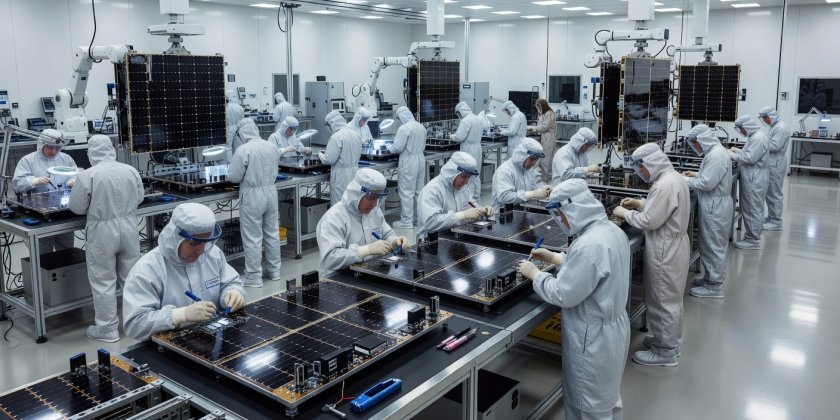
Satellite production line. Technicians test solar array articulation servos and phased-array radar flat antennas under cleanroom air filtration.
Optical Intersatellite Links (OISLs)
The primary bottleneck of early satellite communications was the necessity of having a ground station within direct line of sight. If a satellite flew over the middle of the Pacific Ocean, it had to store data in solid-state buffers or drop connection until reaching a coastal receiver.
Optical intersatellite links use laser transceivers operating in infrared bands (typically 1550 nm) to pass data directly from satellite to satellite at the speed of light in vacuum ($c \approx 300,000\text{ km/s}$). Because light travels roughly $30\%$ faster through hard vacuum than through terrestrial glass fiber cables, satellite laser backbones offer lower latency over intercontinental distances than transoceanic undersea cables.
Orbital Regimes & Operational Roles
| Regime | Altitude Band | Propagation Latency | Primary Use Cases |
|---|---|---|---|
| Low Earth Orbit (LEO) | 300 – 1,200 km | 15 – 35 milliseconds | High-bandwidth internet, high-resolution Earth imaging, SAR monitoring |
| Medium Earth Orbit (MEO) | 2,000 – 20,000 km | 80 – 150 milliseconds | Global navigation satellite constellations (GPS, Galileo, Glonass, BeiDou) |
| Geostationary Orbit (GEO) | 35,786 km | ~240 – 280 milliseconds | Persistent hemispheric weather tracking, legacy satellite broadcast television |
Orbital Congestion & Conjunction Management
With tens of thousands of active payloads now orbiting in low Earth bands, space situational awareness (SSA) has become a safety-critical discipline. At 7.8 kilometers per second, an accidental collision with a 1-centimeter paint fleck or discarded bolt carries the kinetic energy of an exploding artillery shell.
Satellites now execute automated collision avoidance maneuvers driven by real-time orbital tracking data from the 18th Space Defense Squadron and commercial radar networks. Krypton-fueled Hall-effect thrusters fire pulses days in advance to alter the spacecraft's orbital semi-major axis by a few hundred meters, ensuring the probability of collision remains well below the $1 \times 10^{-5}$ intervention threshold.
Demise by Design: Atmospheric Disintegration
To prevent long-term debris accumulation, international guidelines mandate post-mission disposal within 5 years of decommissioning. Manufacturers intentionally construct satellite frames without refractory metals like titanium in primary chassis beams, replacing them with aluminum alloys and optical glass designed to vaporize completely upon aerodynamic atmospheric entry.